Memoir Writing for Seniors: How to Start at 60, 70 or 80
Memoir writing for seniors: pick a scope, get words down without typing, keep a weekly routine, handle memory gaps and hard chapters, and get the book printed.
Make it a book: Write your memoir by answering guided questions. Answer 50 guided questions by writing or speaking, and your stories and photos are printed as a hardcover memoir.
Illustrative image, AI-generated
Plenty of people start their memoir at 60, 70 or 80, and they have one big advantage over younger writers: they know how the story turned out. What tends to stop them is practical. Typing is slow, the eyes tire, a whole life feels like too much to tackle, and some years are hazy.
This guide is about those practical problems. For the craft itself (structure, scenes, voice), see our full guide on how to write a memoir. Here we cover how to choose what to write about, how to get words down without typing, a weekly routine you can keep, what to do about memory gaps and painful chapters, and how to finish with a printed book.
Why Start Now
Looking back is a normal part of later life, not a sign of living in the past. In a 1963 paper, the psychiatrist Robert Butler described the “life review”: a natural process in which older people return to their memories, including unresolved ones, and try to make sense of them. Writing a memoir gives that process a shape and a place to land.
There is some evidence that structured remembering does people good. A 2012 meta-analysis of 128 studies in Aging & Mental Health found that reminiscence and life review programs led to moderate improvements in depression and in ego-integrity (a sense that one's life has hung together and mattered), with smaller gains in purpose in life and sense of mastery. Those were organized programs, often led by trained staff, so writing on your own is not the same thing. Still, the findings fit a simple idea: going back over a life, with some care, can be worth doing for its own sake.
The other reasons are simpler. You have more time than you did. You remember things nobody else alive remembers. And the people who will most want to read it, your children and grandchildren, are often only now old enough to ask.
Choose a Scope You Can Finish
The most common reason a memoir stalls is that it tries to hold everything. Decide early what kind of book you are writing. Four scopes that work well:
- The whole life, in order. Birth to now, a chapter for each stage. Strictly speaking this is closer to an autobiography; our post on memoir vs autobiography explains the difference, but for a family book the label matters less than finishing.
- One period. The farm years, the years in the service, the decade you ran the hardware store, the time you spent raising four children on your own.
- One thread. Your life told through food, through the houses you lived in, through your faith, or through a lifelong friendship.
- A book for one reader. Stories written for a particular grandchild, with “you” in the text. This is often the easiest to start, because you know exactly who you are talking to.
If you can't decide, start with the whole life but write it as separate short stories rather than one long narrative. Each story stands on its own, and if you stop at thirty stories instead of sixty, you still have a book. Our list of memoir chapter ideas has outlines you can borrow.
Ways to Get Words Down Without Typing
Nobody said a memoir has to be typed by the person who lived it. If a keyboard is the obstacle, go around it.
Speak it
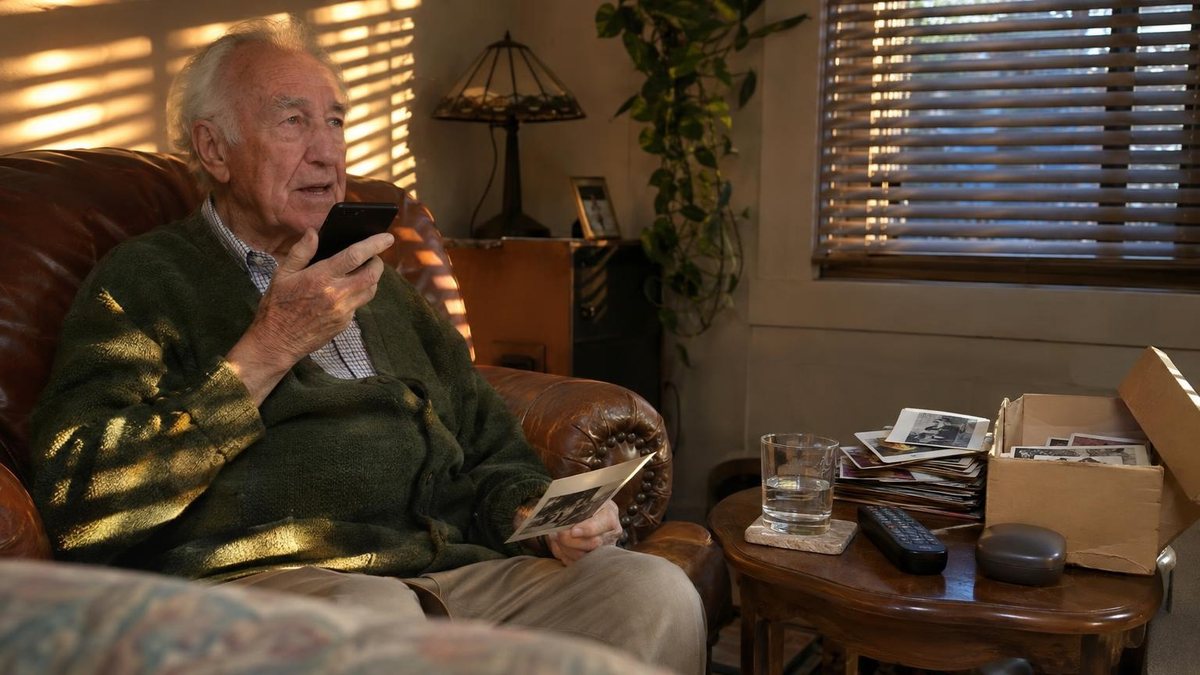
Most phones, tablets and computers can turn speech into text. On a phone, tap the microphone key on the on-screen keyboard and talk. Speak a little slower than normal, and say “period” or “new paragraph” where you want them. Read the result afterward, because names, places and old slang often come out garbled. Many people find that spoken stories sound more like them than anything they would have typed.
Answer one question at a time
“Write about your childhood” is hard. “What did your mother make for supper on Fridays?” is easy, and the answer leads somewhere. Work from a list of specific questions and answer one per session. Our memoir prompts are a good source, and our journal prompts for seniors are gentler warm-ups for days when a full story feels like too much.
Bring in a family helper
A son, daughter or grandchild can act as interviewer and typist. You talk; they ask follow-up questions and type, or record and transcribe later. Agree on one rule at the start: they write down what you said, in your words, and save their own opinions for the margins. For example, an hour on a Sunday afternoon might produce one story of five or six hundred words, and over a year that adds up to a real book.
Write by hand and hand it over
If you think best with a pen, write in a wide-ruled notebook and let someone else type it up. Leave a blank line between paragraphs so corrections are easy, and number the pages.
A Realistic Weekly Routine
Big writing sessions are tiring and easy to skip. Short ones done on set days get books finished. Here is one routine that produces one story a week with about an hour of work in total:
| Day | What to do | Time |
|---|---|---|
| Monday | Pick this week's question or memory and jot down a few words about it | 10 minutes |
| Tuesday | Write or speak the first draft, start to finish, with no corrections | 20 to 30 minutes |
| Thursday | Add one detail you left out: a name, a smell, something someone said | 15 minutes |
| Saturday | Read it aloud, or have someone read it to you, and fix what sounds wrong | 15 minutes |
Keep the other days free. At one story a week you would have around fifty by the end of a year, which is plenty for a family memoir. If a week gets away from you, pick up where you left off; there is no need to catch up.
When Your Memory Has Gaps
Everyone's memory has holes, at any age. A memoir is your account of your life, not a court record, and readers understand that. A few ways to fill in what you can:
- Look at the backs of photos, old letters, calendars, report cards and pay slips. Dates and addresses often turn up there.
- Ask a sibling or old friend what they remember about the same event. You may get a different version, and that can be worth including.
- Look yourself up in the census. US census records open to the public 72 years after they are taken, and the 1950 census is free to search from the National Archives. If you were alive in 1950, you may find your family's household, street and the jobs the adults listed.
- Build a rough timeline first. Put the years down one side and the big events beside them. A personal timeline makes it easier to place the stories you are unsure about.
- Say so when you aren't sure. “I think it was the summer of 1962” is honest and reads naturally. Don't let one missing date stop a good story.
Writing the Hard Chapters
Most long lives include losses, mistakes and years that nobody would choose. You decide what goes in. Some people leave a hard chapter out entirely; others write a paragraph that acknowledges it and moves on; others find that writing it in full is the reason they started.
- Write it for yourself first. You can decide later whether it goes in the book.
- Leave the hardest chapter until you have a dozen easier stories done. By then you will know your own voice.
- Write about what happened and how it affected you, rather than guessing at other people's motives.
- Think about the living people in the story. Changing a name or leaving out a detail is fair if it protects someone.
- Stop when you need to. If a memory stirs up more than you can comfortably carry, talk to someone you trust, or to your doctor.
Adding Photos
Photos bring a family memoir to life, and they also jog the memory. Go through them chapter by chapter rather than all at once, and pick a few that go with each story. Under each one, write who is in it, where and roughly when. A photo of “Mom and Aunt Rose, Coney Island, about 1958” will mean something to a great-grandchild; an unlabeled one won't.
Scan or photograph the prints you choose, and keep the originals safe. The National Archives advises storing family photos and papers somewhere cool and dry, away from damp basements, hot attics and the floor, and keeping rubber bands, paper clips and tape off them.
Getting It Printed
A finished manuscript deserves to be a real book. There are a few routes. A local print shop can print and bind a small run from a document file. Self-publishing services will print a single copy on demand if you prepare the layout yourself, or with help from a family member who is comfortable with design software. Either way, budget time for a careful read-through before anything goes to print, ideally by someone other than you.
If you would rather not deal with files and layouts at all, Memowrite is built for this. You answer 50 guided questions about your life, by writing or by speaking, and add your photos. Your answers are printed as a hardcover memoir book of up to 500 pages with up to 100 photos. Plans start at $99, and the pricing page shows what each one includes.
Frequently Asked Questions
Am I too old to write a memoir?
No. There is no upper age limit on telling your own story, and a longer life simply means more to choose from. If energy or eyesight is the issue, shorten the sessions, speak instead of typing, or ask a family member to help. One story a week is enough to finish.
Do I need to be a good writer?
No. Families want your stories in your voice, not polished prose. Write the way you talk, keep sentences short, and include specific details: the name of the street, the make of the car, what your father said. Those details matter far more than grammar.
How long should a memoir for my family be?
As long as it needs to be. Thirty to fifty short stories of a page or two each make a good-sized family book. It is better to finish a shorter book than to leave a long one half done.
Where can I find a memoir writing class for seniors?
Ask at your public library, senior center, community college or place of worship whether they run a memoir or life-writing group. A group gives you deadlines, encouragement and readers. If you can't get to one, a weekly phone call with a friend who is also writing can do much the same job.
Can someone else write my memoir for me?
Yes. A family member can interview you and write up your answers, or you can hire a professional writer. The more of your own words end up on the page, the more it will sound like you, so even if someone else does the typing, make sure the stories come from you.
Written by Memowrite Team
The people who build and run Memowrite write and edit every article on this blog.
More about the Memowrite TeamStart your own book today
Answer 50 guided questions by writing or speaking, and your stories and photos are printed as a hardcover memoir.