
Tribute book guide
How to Write a Tribute to Someone Who Passed Away
Updated
Writing a tribute to someone who passed away is one of the hardest things people are asked to write. This guide takes it one step at a time, for a short tribute read at a funeral or memorial and for a longer one written over months. If you would like to gather many memories into a printed book, that is what a tribute book is for.
What a Tribute Is, and What It Is Not
A tribute is a piece of writing about who someone was and what they meant to the people around them. It is not an obituary, which records the facts of a life and the details of the service, and it does not need to cover every year. A eulogy is a tribute given as a speech at the funeral. The same steps work for both.
The tributes people remember are specific. They let the listener see the person: the way she laughed at her own jokes before the punch line, the way he could never walk past a hardware store. A list of good qualities tells people what to think. A story lets them recognize the person they knew.
Before You Start: Give Yourself Room
Grief makes concentration hard. If there is a service in a few days, know that a tribute can be short and still be enough. If there is no date, there is no need to rush. Many people write a first version for the service and a fuller one later, when they are ready.
It can help to write with someone else in the room, or to talk your memories through out loud first and write afterward. You don't have to do this alone, and you don't have to get it right the first time.
Step 1: Gather Memories
Before you write a sentence, collect material. Sit with photos, old cards and messages. Ask a few people who knew them for one memory each. Write everything down as a rough list, in any order. If you get stuck, our memory book questions can help bring things back.
- Who they were: three words that describe them, what they were known for, what they cared about.
- Their sayings: phrases they repeated, the way they signed a card, what they always said at the door.
- Stories: two or three moments that show who they were. Small ones are often the best.
- What they gave: what they taught you, what they did for others, what you do now because of them.
Step 2: Choose a Few Things to Say
You can't say everything, and you don't need to. Look at your list and mark the two or three things that feel most like them. One story told in detail does more than ten mentioned in passing. If you are writing on behalf of the family, choose things others will recognize, and leave private matters private.
Step 3: Give It a Simple Shape
A tribute doesn't need a clever structure. This one works whether you are writing a few paragraphs or a few pages:
- Open with who they were to you. One plain sentence, such as: “My grandmother taught me to play cards, and then refused to let me win for years.”
- Tell a story or two. Set the scene in a sentence, then say what happened, including what they said.
- Say what they gave. What they taught you, how they treated people, what is different because they were here.
- Close with how you will carry them. A tradition you will keep, a saying you will pass on, or simply a thank-you.
Step 4: Write It the Way You Would Say It
Write in your own voice, as if you were telling a friend about them. Short sentences are fine. You can use humor; many tributes make people laugh, because the person being remembered made people laugh. Use their words and their nicknames. If a sentence sounds like a sympathy card, replace it with something only you would say.
It is also fine to be honest. If they were stubborn, say so, kindly. People will recognize the person, and that recognition is part of the comfort.
Step 5: Read It Aloud and Trim
Read your draft out loud, slowly. Cut anything that trips you up or that you would not say in front of the whole family. If you will read it at a service, ask how much time you have; a tribute that takes a few minutes to read is usually one or two typed pages. Print it in a large font, mark where you want to pause, and ask someone to stand by to finish reading it if you can't. Nobody minds if your voice breaks.
Writing a Tribute to Your Mother, Father or Another Family Member
When the person is a parent, it can help to write about them as a person first and as your parent second: who they were before you were born, what they loved apart from the family. Then come to what they were like as your mom or dad. For a grandparent, ask your parents and older relatives for stories from before your time.
For a brother or sister, the shared childhood is often the heart of it: the bedroom you shared, the fights, the moment you became friends. For a spouse or partner, you may want to keep some things for yourself. A tribute others will hear or read doesn't need to hold everything you shared.
From a Tribute to a Tribute Book
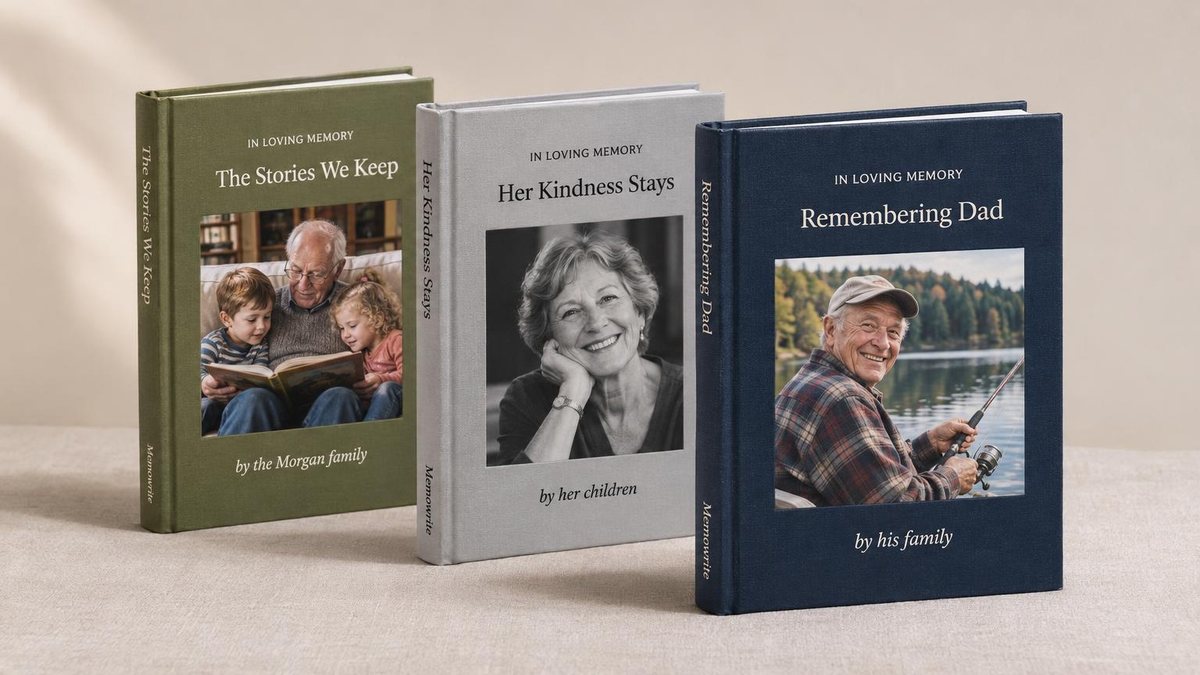
A tribute written for a service is often the first page of something longer. After a funeral, people tend to share the stories they didn't get to tell. You can invite them to send a memory by card or message and gather them over a few months. Some families arrange these into chapters: early life, family, work, the things they loved, what they taught us. Our page of tribute book ideas has outlines and titles you can borrow.
A Memowrite tribute book offers guided questions about the person you are remembering. You answer by writing or by speaking, at your own pace, and can add up to 100 photos. The stories are printed as a hardcover book once they are ready. We can't promise a book in time for a funeral or memorial, and there is no need to rush one. If the person you want to honor is living, a love story book lets you tell them what they mean to you while they can read it.
Frequently Asked Questions
How long should a tribute be?
Long enough to tell one or two stories well. For a service, check how much time you have; a few minutes of reading is common. A written tribute for a card, a memorial page or a book can be any length.
What is the difference between a tribute and a eulogy?
A eulogy is a speech given at a funeral or memorial. A tribute is any piece written in honor of someone, spoken or not. In practice the two overlap, and the same steps work for both.
How do I start a tribute to someone who passed away?
Start with who they were to you, in one plain sentence. “My dad was the first one up every morning and the last to leave every party” tells people who you are talking about and how you knew him. Then move into a story.
Can I write a tribute months or years later?
Yes. Some of the most thoughtful tributes are written long after the funeral, for an anniversary, a birthday or a family gathering. Time can make it easier to see what mattered most.
What if I can't stop crying when I try to write?
That is a normal part of it. Write in short sessions, talk the memories out loud to someone and let them take notes, or start with the lighter stories. If it is too much right now, put it aside. The memories will keep.
If you would like to keep these memories in a book
A Tribute book offers guided questions about the person you are remembering. You can answer by writing or speaking, at your own pace, add photos, and the stories are printed as a hardcover book once they are ready.