
Faith & Testimony guide
How to Write Your Testimony: A Step-by-Step Guide
Updated
Writing your testimony means putting into words how faith has worked in your life: where it began, what changed, and what it means to you now. This guide shows how to write your testimony step by step, whether you need a single page to share at church or a baptism, or want to tell the whole story in a Faith & Testimony book for your family.
The steps come from the Christian practice of giving a testimony, and they work just as well for people of other faiths who want to tell how belief has shaped their life. Use the words your own tradition uses.
What a Testimony Is
A testimony is your own account of faith in your life. It is not a sermon or an argument, and it does not need to persuade anyone. Its strength is that it is yours: specific, honest and in your own words. Nobody can say you are wrong about what happened to you.
Some testimonies tell of a single dramatic moment. Many more tell of faith that grew slowly, from childhood, through doubt, into something steadier. Both are testimonies. If you have always believed, your story is about how that faith was tested, deepened or made your own.
Step 1: Reflect Before You Write
Set aside quiet time. Many people begin with prayer or a time of reflection, asking for honesty and clarity. Then take a sheet of paper and draw a line across it for your life so far. Mark the moments when faith mattered most: a first memory of church or prayer, a time of doubt, a decision, a loss, an answer, a change in how you lived.
Our testimony questions can help bring these moments back, from faith in your childhood home to what you would pass on.
Step 2: Choose Your Focus
Look at your timeline and ask which part of the story you want to tell. For a short testimony, choose one thread: how you came to faith, how faith carried you through a hard time, or how it changed the way you treat people. You can't tell everything in a few minutes, and you don't need to. For a longer written testimony, you can follow several threads across your whole life.
Step 3: Use a Simple Shape: Before, Turning Point, After
Many testimonies follow three parts. They give the listener something to hold on to:
- Before: what your life and your heart were like. Be specific: what you were looking for, what you were afraid of, what you leaned on instead.
- The turning point: what happened, when and where, who was there, and what you understood or decided.
- After: what has changed since, and what is still a struggle. Give one or two concrete examples of faith in your daily life now.
If you grew up in faith, the shape still works: before can be a faith you inherited, the turning point the moment it became your own, and after the way you live it now. Our testimony template has fill-in outlines for each version.
Step 4: Write Honestly and Specifically
- Tell a story, not a summary. “I sat in my car outside the hospital and couldn't go in” says more than “it was a hard time.”
- Be honest about doubt and failure. Listeners trust a testimony that admits the struggle.
- Avoid insider words that a newcomer wouldn't understand, or explain them in plain language.
- Keep the attention on what happened, not on how bad you were. You don't need to describe every past mistake in detail.
- If a passage of scripture or a teaching mattered, say which one and what it meant to you, in your own words.
- Protect other people. Change or leave out names when a story involves someone else's private life.
Step 5: Shorten It for Speaking
If you are sharing your testimony in church, before a baptism or in a small group, ask how long you have. A spoken testimony of a few minutes is often about one typed page. Read your draft aloud and cut anything that doesn't serve the main thread. Practice it a few times so you can look up from the page, and end with one clear sentence about what faith means to you today.
Writing Your Testimony for Your Family
A testimony written for your children and grandchildren can be longer and more personal than one written for a service. They will want the details: the church you went to as a child, the people who prayed for you, what you were thinking on the day you made your decision, how faith helped when they were born or when they were struggling. Some people write it as a letter to them. Others write it as a book they can return to.
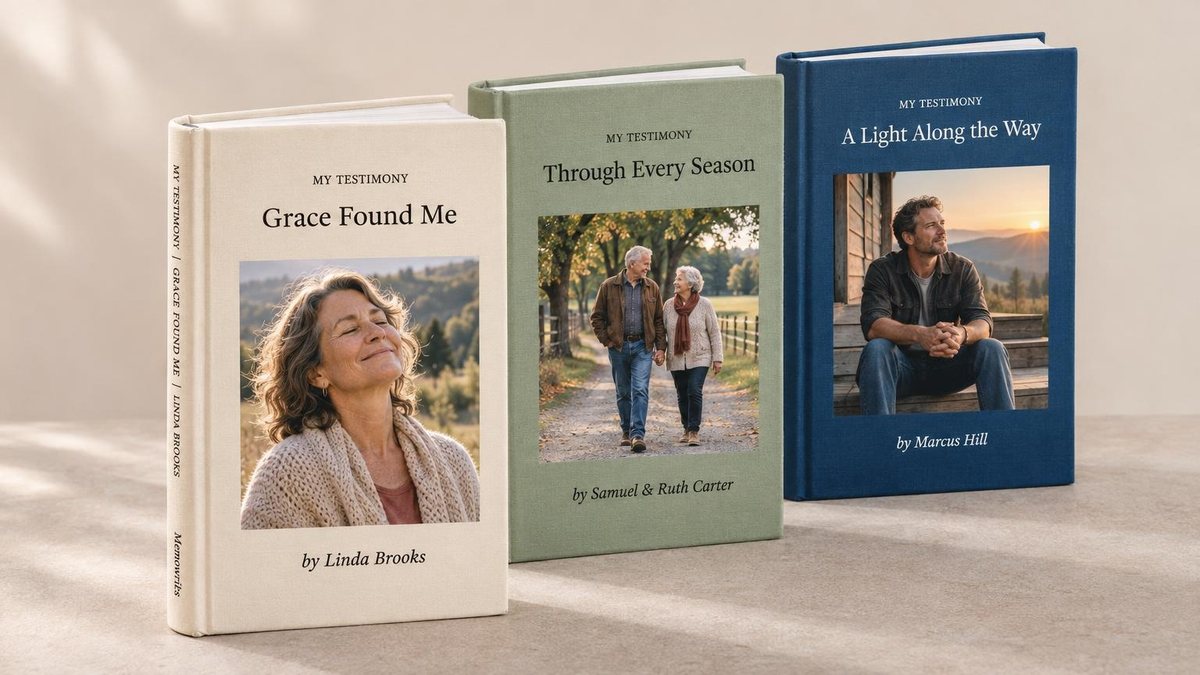
A Memowrite Faith & Testimony book gives you guided questions about your faith and your life, answered by writing or by speaking, at your own pace. Every plan includes 50 guided questions and you can add your own. Your answers are printed as a hardcover book of up to 500 pages, with up to 100 photos. You can see how it works step by step.
Frequently Asked Questions
How do I write my testimony if I'm not a writer?
Write the way you would tell it to a friend over coffee. Plain words and short sentences are fine. If writing is hard, talk it through out loud or record yourself, and write it down afterward.
What should I include in my testimony?
What your life was like before, what happened at the turning point, and what has changed since, with one or two real examples. Include honest struggle as well as answers. Leave out details that aren't needed to tell the story.
How long should a written testimony be?
For church or a baptism, often about one page, depending on the time you are given. A testimony written for your family can be as long as your story needs, from a long letter to a whole book.
What if I don't have a dramatic conversion story?
Most people don't. A testimony of faith that grew steadily, or that held through ordinary hard times, is just as true and often easier for listeners to relate to. Tell the moments when your faith became your own.
Can I write a testimony if I'm not a Christian?
Yes. The word comes from Christian practice, but the idea of telling how faith has shaped your life belongs to every tradition. Use the language your community uses, and follow the same steps.
Keep your testimony in a book
A Faith & Testimony book gives you guided questions about your faith and your life. Answer by writing or speaking, add photos, and your story is printed as a hardcover book for your family. Plans start at $99.