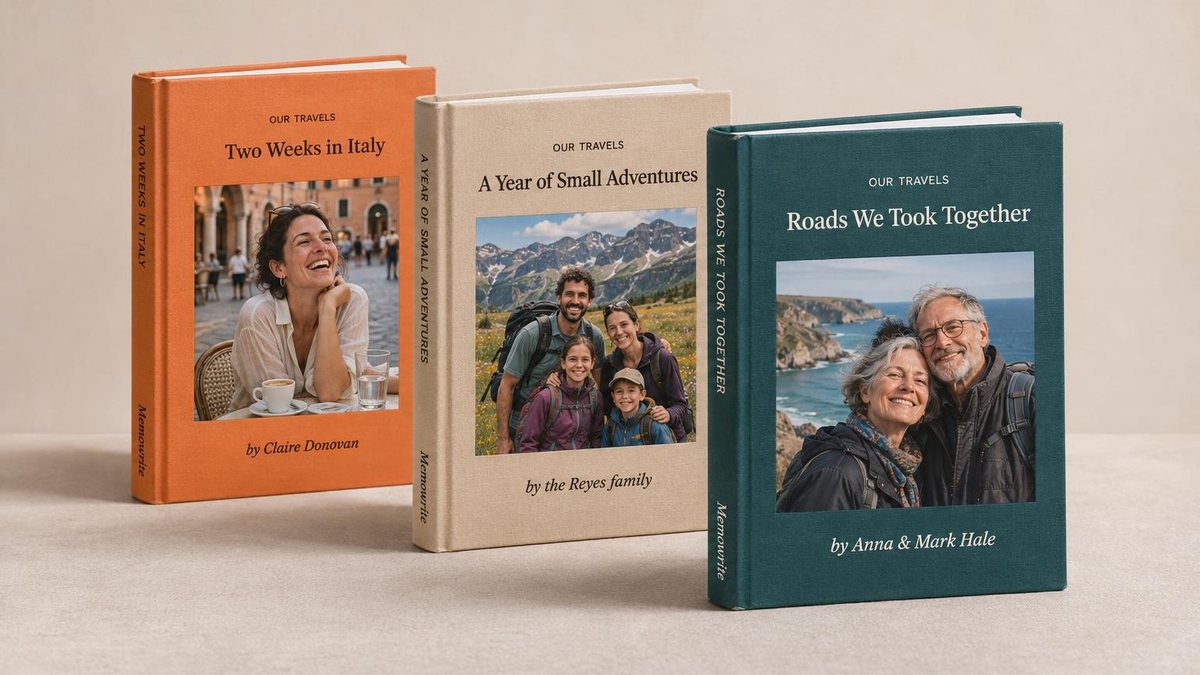
What goes in a travel memory book
Think of it as the trip told in chapters. You don't need to cover every day. The parts that make the best reading are the ones you would tell a friend over dinner:
- Why you went, and what you expected before you left
- Getting there: the delays, the long drives, the first view out of the window
- The places you stayed and the people who ran them
- Meals you still talk about, and the one that went badly wrong
- People you met along the way, even for an afternoon
- The day nothing went to plan
- What you brought home that wasn't in your suitcase
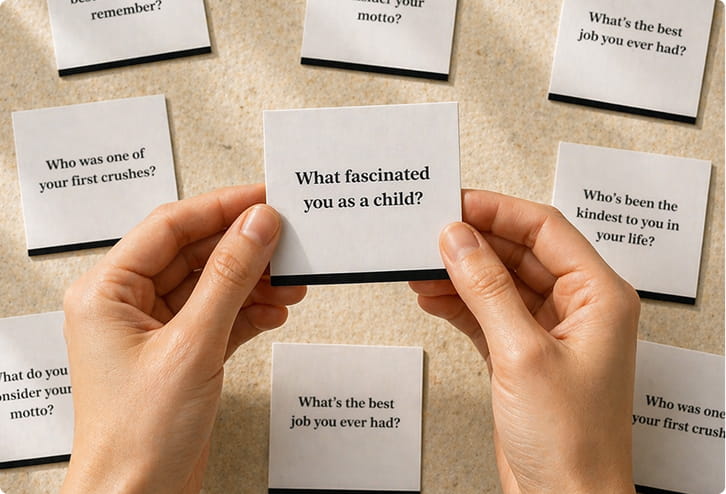
Every plan includes 50 guided questions. You can add your own, skip any that don't fit your trip, and answer as many or as few as you like. If one trip feels too small for a whole book, cover a year of travel instead: a chapter for each place, or one for each person you went with.
How to turn vacation photos into a book that tells the story
A photo book is a good way to show your pictures, and if the pictures are all you want, it does that job well. This is a different kind of book. It starts with the stories, and the photos go in beside them.
A simple way to go about it:
- Go through your photos once and pick the ones that each have a story behind them. You can include up to 100.
- Answer the questions in any order. Start with the moment you most want to remember.
- If typing on your phone is slow, answer by speaking instead.
- Ask the people you traveled with what they remember. Their version of a day is often funnier than yours.
When your stories are ready, the book is printed as a hardcover, with up to 500 pages and your photos in full color, and shipped to you. How it works walks through each step.
A travel memory book for couples
Trips are often where couples find their best stories: the wrong train, the room with the view, the argument over the map that you both laugh about now. A travel memory book for couples keeps both of your versions.
The simplest way is to sit down together and take the questions in turn, with one of you typing or both of you talking. You will find you remember different things. Put both in. A trip you took together years ago works just as well as last summer's.
For a once-in-a-lifetime trip: honeymoon, retirement, gap year
Some trips deserve more than an album. A honeymoon is the first chapter of a marriage. A retirement trip is often one you planned for years. A gap year can change who comes home. These are the trips you will want the details of later, not only the views.
- Honeymoon: the wedding still close behind you, the places you chose together, and what you talked about on the long evenings.
- Retirement trip: where the idea came from, how long you saved and planned, and what it felt like to have no work to get back to.
- Gap year: where you went, the jobs and friends along the way, and how you had changed by the time you came home.
There is no deadline, so you can start a few weeks after you get back or many years later.
Who a travel book suits, and who it may not
It suits people who come home with stories as well as photos: the ones who tell the same trip at every family dinner, or who wish they had kept a journal and never did. It suits grandparents who want their grandchildren to know about the trip they took at twenty, and couples who want to keep the trip that mattered most.
It may not suit you if you mainly want your photos shown large, page after page, with few words. A book like this needs your stories to work. If you would rather not write or talk about the trip, a simple album is the better choice.
Plans are $99 for the Classic Travel Book, $139 for the Photo Travel Book and $169 for Family Travel Books, each paid once, with a 30-day money-back guarantee. See pricing for what each includes.