
Travel guide
How to Write a Book About Your Travels: One Trip or a Lifetime of Them
Updated
A book about your travels keeps what the photos can't: why you went, what went wrong, who you met and how it felt. This guide shows how to write a book about your travels step by step, whether it covers one trip, a year away or a lifetime of holidays, and whether the trip was last month or thirty years ago. The same method works for a notebook and for a travel memory book printed from your answers.
What a Book About Your Travels Is For
Your camera roll is already a record of where you were. A book about your travels is the record of what happened there. The photo shows the view from the ferry; the book says you nearly missed it, ran the last hundred yards with your bag bouncing, and that your sister didn't stop laughing until the island came into view. Years later, the photo reminds you of the place. The story brings back the day.
So the aim is not to log every museum and meal. It is to tell the moments you would tell a friend about, in an order that reads like a story.
Step 1: Decide What the Book Covers
Choose the frame before you write, because it decides what goes in and what stays out:
- One trip: a honeymoon, a big birthday trip, a summer away. The book can follow the days in order.
- A year of travel: several trips, or a long stretch abroad. Group it by place or by season.
- A lifetime of travel: the family road trips, the places you lived, the trips you still talk about. Choose the best stories rather than every trip.
- One place over many visits: the lake cabin, the grandparents' town, the city you keep going back to.
Step 2: Gather What You Already Have
Most of the material for a book about your travels already exists. Before you write, collect it:
- Go through your photos in order. Note each one that has a story behind it.
- Check your messages from the trip. What you sent home often says more than you remember.
- Lay out tickets, receipts and maps to rebuild the order of the days.
- Find any notes or journal pages you kept on the road, however short.
- Ask the people you traveled with for their best memory. Their version may surprise you.
Writing after the trip has one advantage: you know which moments lasted. The things you are still talking about a month or a decade later are the ones to write first.
Step 3: Write One Story at a Time, With a Simple Template
Don't start at the airport and work forward. Start with the story you most want to keep, and give each story the same five parts. It keeps you from staring at a blank page:
- Where and when: the place, the day, and the weather if it mattered.
- One moment: the single scene you most want to keep. Not the whole itinerary.
- The people: who was there, and one thing someone said.
- One detail for each sense you can recall: a smell, a sound, a taste, the light.
- One line on what it meant: why this moment stayed with you, or what it changed.
An Example Story
Here is a short example of the template in use, from an imagined trip:
Day four, a hill town, rain until noon. We waited out the storm in a café with six tables and no menu. The owner brought us whatever she was cooking for her own lunch, a bean soup with bread torn into it, and refused to let us pay for the second bowl. Her grandson translated, badly and proudly. The windows steamed up, a radio played something with accordions, and the whole place smelled of wet coats and garlic. We had planned to see the cathedral. We never did, and I don't mind at all.
It is about a hundred words. It has a place, one moment, people, the senses and a closing line. A book about your travels can be built from twenty or thirty stories like it.
Step 4: Write Scenes, Not Itineraries
“Visited the old town, then the market, then dinner” is easy to write and dull to read. It also tells you nothing ten years later. Pick one scene and tell it properly. A few habits help:
- Name things. The street, the dish, the bus number, the woman at the front desk.
- Write down what people said, as close to word for word as you can.
- Include what went wrong. Missed connections and wrong turns are the stories you will retell.
- Write how you felt, honestly. Tired, lost, bored, delighted, homesick.
- Leave out what you'd find in a guidebook. Your book is for what only you saw.
If you need a nudge, our travel journal prompts give you more than a hundred questions, from the drive to the airport to the first evening back home.
Step 5: Let the Photos Support the Story
Photos and words work best together, with each picture next to the story it belongs to. Choose fewer photos and give each one a caption that says where, when and what was happening just before or after. A photo of a plate of pasta is a picture of food. The same photo with “The waiter who insisted we try his mother's recipe” is a memory.
Step 6: Give the Book a Shape
Once you have a handful of stories, put them in order. Three shapes work well:
- Day by day, for a single trip, from the planning to the first evening home.
- Place by place, for a long trip or a year of travel, one chapter for each stop.
- By theme, such as food, people, the days that went wrong and the best day, for many trips over many years.
Open with why you went and close with what you brought back, even if that is only a habit or a phrase. Our travel memory book ideas show full outlines and title ideas.
If You Are Still on the Road
You don't need to write the book during the trip. Take two minutes each day to jot three words or a voice note about the best moment, and keep tickets and receipts in one envelope. Those notes will carry you through the writing once you are home.
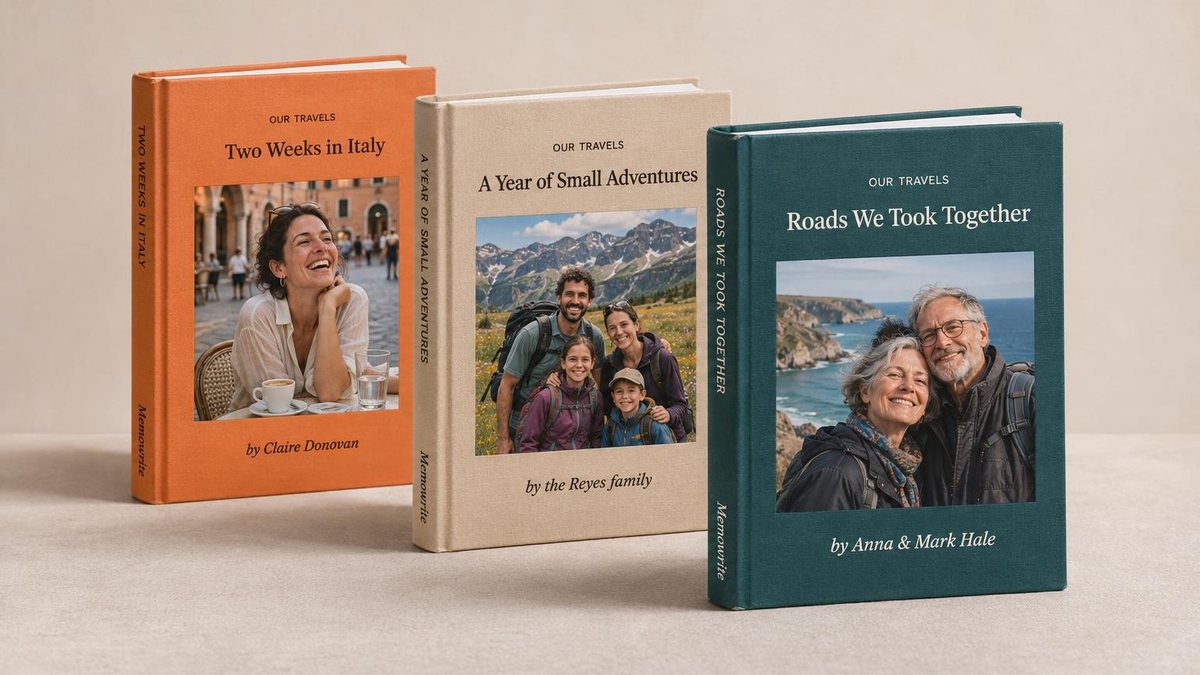
A Memowrite Travel book gives you guided questions about your trip, or a year of travel, answered by writing or by speaking, at your own pace. Every plan includes 50 guided questions and you can add your own. Your answers are printed as a hardcover book of up to 500 pages, with up to 100 photos in full color. You can see how it works step by step.
Frequently Asked Questions
How do you write a book about your travels?
Decide what the book covers, gather your photos, messages and tickets, then write one story at a time: where and when, one moment, the people, a few sensory details and a line on what it meant. Put the stories in order once you have a handful.
Can I write about a trip years later?
Yes. Work from your photos, messages and receipts, and write the moments you still remember first. The stories that lasted are often the best ones, and the people you traveled with can fill in what you have forgotten.
How long should each story be?
As long as the moment needs. A hundred words is often enough for a good story. The best day of the trip may take a few pages; a funny sign may take two lines.
What should I include in a book about my travels?
Why you went, first impressions, where you stayed, meals, people you met, the day things went wrong, the best day, and what you brought home. Add photos with short captions next to the stories they belong to.
What is the difference between a travel journal and a book about your travels?
A travel journal is usually written during the trip, a few lines at a time. A book about your travels is put together afterward, with the stories and photos arranged in order. A journal, if you kept one, is the best source for the book.
Turn your travels into a book
A Travel book gives you guided questions about your trip or a year of travel. Answer by writing or speaking, add up to 100 photos, and your stories are printed as a hardcover book. Plans start at $99.