
Memoir chapter ideas
Memoir Chapter Ideas: Chapter Outlines and Titles for a Life Story
Updated
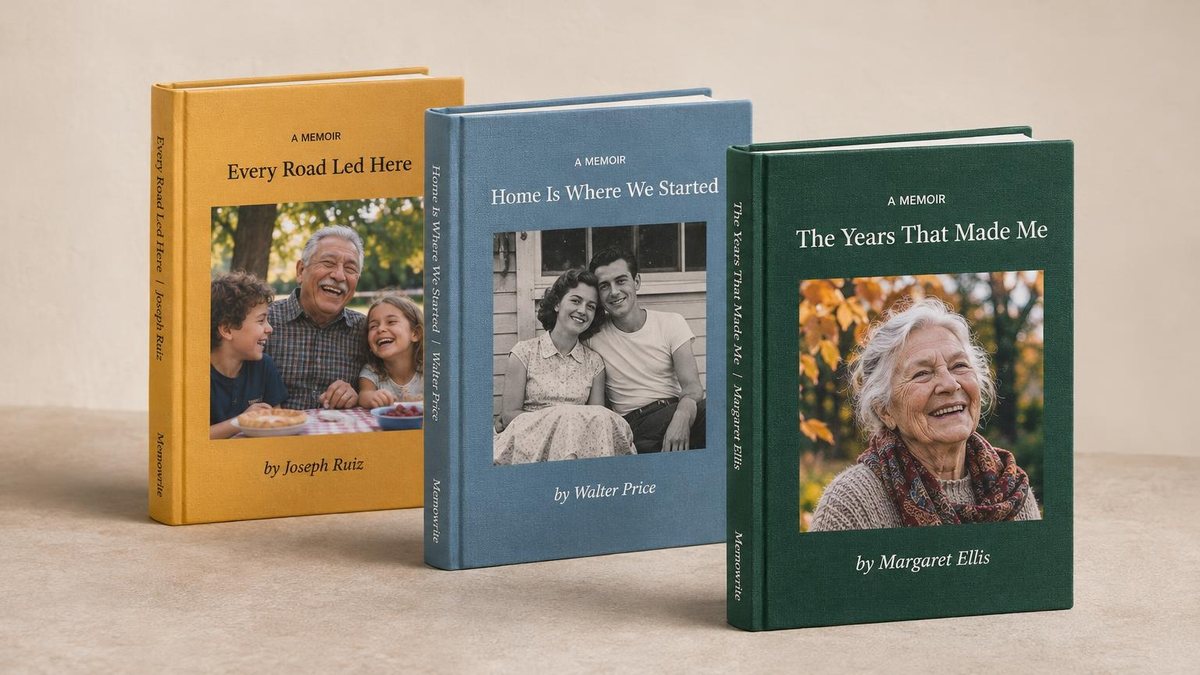
These memoir chapter ideas are for shaping a life story into chapters, whether you are writing your own or a parent is writing theirs for the family. You will find five ways to arrange a memoir, a sample chapter outline, chapter titles for each stage of life and tips on length. The memoir book page explains how Memowrite's guided questions become a printed hardcover.
This page is about structure. For the writing itself, see our guide on how to write a memoir; for ideas of what to write about, see our memoir prompts.
Five Ways to Arrange Memoir Chapters
Most family memoirs use one of these shapes, or a mix. Choose the one that fits the stories you already have.
- By life stage: childhood, school, young adulthood, work and family, later life. Easy to follow, and the natural choice for a whole life.
- By place: one chapter for each home, town or country. Good for a life with several moves.
- By people: a chapter for each person who shaped the life: parents, a teacher, a spouse, the children, a best friend.
- By theme: work, love, faith, food, music, money. Each chapter moves through the years on its own thread.
- By object or photo: each chapter starts with a photograph or a keepsake and tells the story behind it.
A Sample Memoir Chapter Outline
This memoir chapter outline follows a life in order. Rename, merge or skip chapters to fit; a family memoir rarely uses all of them.
- 1. Before Me: parents, grandparents and the family stories that came first.
- 2. The House I Grew Up In: the rooms, the street, the neighbors.
- 3. School and Friends: teachers, games, the friend you got into trouble with.
- 4. Growing Up Fast: teenage years, first jobs, the world outside.
- 5. Leaving Home: where you went, and why.
- 6. Meeting the One: love, courtship, the wedding or the decision.
- 7. Work: how you earned a living, and what it taught you.
- 8. Raising a Family: the children, the chaos, the traditions you started.
- 9. The Hard Years: a loss, an illness, a move, a setback, and how you came through.
- 10. Friends and Neighbors: the people who stayed.
- 11. Later Life: grandchildren, new interests, what a good day looks like now.
- 12. What I Want You to Know: lessons, beliefs, and a letter to the family.
Memoir Chapter Title Ideas by Stage of Life
Chapter titles can be plain or full of character. A phrase, a place or something someone said makes a chapter easy to find again.
Family roots
- “Where the Name Comes From”
- “My Mother's Side”
- “The Boat, the Train and the Rented Room”
- “Stories I Heard at the Kitchen Table”
Childhood
- “The Back Porch”
- “Saturday Chores”
- “The Winter of the Big Snow”
- “Seven Kids, One Bathroom”
School and teenage years
- “The Teacher Who Noticed”
- “Borrowing the Car”
- “My First Paycheck”
- “Seventeen and Sure of Everything”
Love and marriage
- “The Dance Where I Met Your Grandfather”
- “Letters Across the Country”
- “A Small Wedding and a Big Cake”
- “Our First Apartment Had No Oven”
Work
- “Night Shifts”
- “The Shop on Main Street”
- “The Boss Who Gave Me a Chance”
- “Thirty Years at the Same Desk”
Family life
- “The Day You Were Born”
- “Sunday Dinners”
- “Road Trips With Four Kids and No Air Conditioning”
- “The Christmas the Tree Fell Over”
Hard times and later life
- “The Year We Started Over”
- “What Got Us Through”
- “Retirement, or So They Called It”
- “Grandchildren Change Everything”
- “Things I Know Now”
How Long Should a Memoir Chapter Be?
There is no rule. In a family memoir, chapters often run a few pages each, built from several short stories. Shorter chapters are easier to write one at a time and easier for younger readers to dip into. If a chapter grows much longer than the others, it may be two chapters; if one stays thin, merge it with its neighbor.
Tips for Building Chapters
- Write the stories first and sort them into chapters later. Outlines are easier to fill from below.
- Open each chapter with a scene rather than a date: a room, a voice, a smell.
- End a chapter with a small turn, such as a decision, a move or a line someone said, to carry the reader into the next.
- Add a photo or two to each chapter, with a caption saying who, where and roughly when.
- Keep a list of stories that don't fit anywhere yet. They often become a chapter of their own.
Letting the Chapters Form From Questions
If outlining feels like homework, start with questions instead. With Memowrite, the person telling the story answers guided questions about their life by writing or by speaking, at their own pace. Every plan includes 50 guided questions and you can add your own; the answers are printed as a hardcover book of up to 500 pages with up to 100 photos. Once the chapters are in place, memoir title ideas can help name the whole book.
If you want to tell your whole life in order, from your family's roots to today, our autobiography outline is a closer fit.
Frequently Asked Questions
How many chapters should a memoir have?
As many as the stories need. Ten to fifteen chapters is a comfortable range for a family memoir covering a whole life; a memoir about one period may need fewer. Merge thin chapters and split long ones.
Does a memoir have to be in chronological order?
No. Many memoirs are arranged by place, by people or by theme. Chronological order is simply the easiest to follow, which is why most family memoirs use it.
How do I outline memoir chapters?
List the stories you want to tell, one line each. Group them by life stage, place, people or theme, give each group a working title, and put the groups in order. The sample outline above is a starting point.
Should memoir chapters have titles?
It helps in a family book. Titles make it easy to find a favorite story again, and a good one, such as a place or a saying, adds character. Numbers alone work too.
Fill the chapters one question at a time
A Memowrite memoir starts with 50 guided questions, answered by writing or speaking. Add photos, and the stories are printed as a hardcover book. Plans start at $99.