Maria Kontrim ·
How to Build a Personal Timeline That Tells Your Whole Story
A personal timeline lays your life events out in order. Learn simple steps, template ideas, and a timeline example to map your story from birth to now.
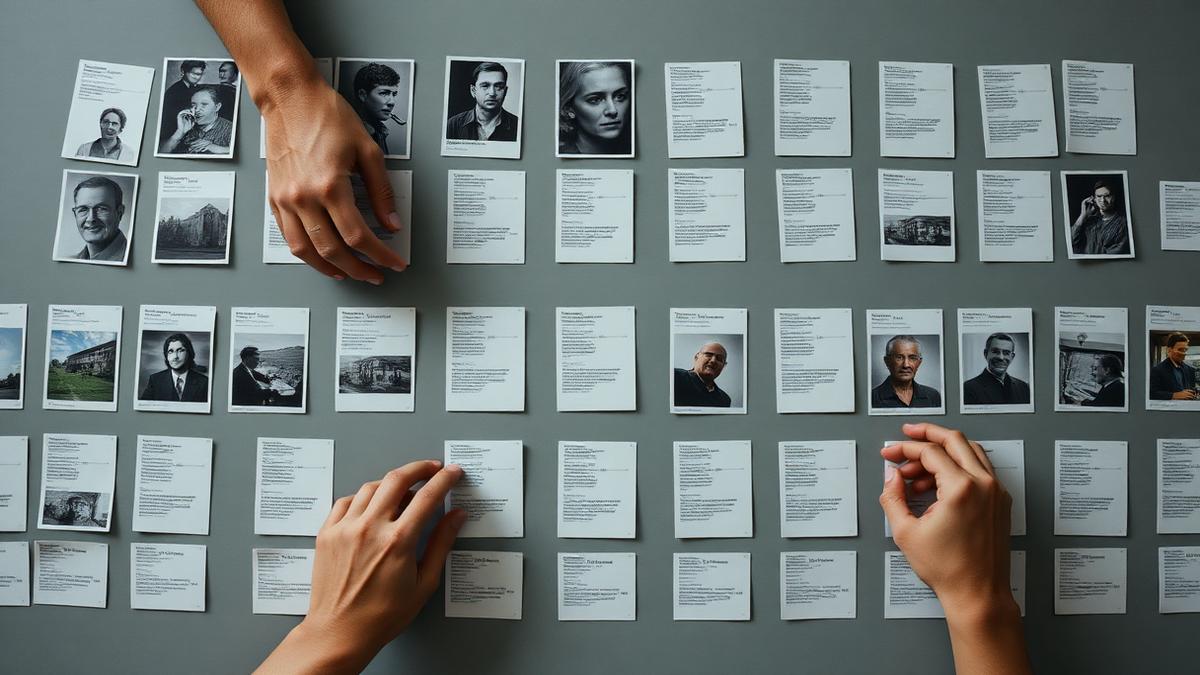
A personal timeline is one of the simplest tools for making sense of your own life and telling your story. Instead of trying to hold every memory in your head at once, you lay your biggest moments out in order, and your story starts to take shape on the page.
We’ll cover what a personal timeline is, how to build one, and some examples that can help you build a personal timeline for almost any project, be it a school project or a full memoir.
What Does Personal Timeline Mean in Storytelling?
A timeline is a way to lay out events in the order they happened. A personal timeline does the same job, but it only covers you. It outlines your childhood, education, first job, moves, big wins, and hard years, then lines them up from your first day to today.
This is different from a timeline built to teach history. A textbook might use a timeline to show historical events like wars or elections. Your personal timeline only needs the moments that shaped who you are now, placed in chronological order so the story flows the way your life actually happened.
Research has shown that our brains already use a similar technique. A study from Michigan State University's ICER lab found that people naturally search their memories along a mental timeline, and events placed near each other in time are easier to recall together. Writing or remembering your life story in the personal timeline format is just you copying a trick your brain already uses.
Why Make a Timeline of Your Life
A timeline of life events gives you a whole picture, distanced from the events themselves. When your life is laid out on a page, patterns show up that you never noticed while you were living through them. Maybe every big move led to a new hobby. Maybe every hard year was followed by a better one.
Writers use this method to plan memoirs. Students use it for class projects. Job seekers use it to sort out their plans and see where they want to go next. Even a short list of life events can turn a jumble of memories into a story with a clear beginning, middle, and end.
A study from the Journal of Cognition and Development found that people remember events more clearly when those events are placed along a spatial timeline instead of recalled at random. This means writing your life out in order can even help you remember more of it.
How to Create Your Personal Timeline Step by Step
You don’t need special skills to build a personal timeline. You just need to be able to sit with your own memories for some time.
Step 1: Collect your events first.
Grab a notebook or open a blank document. Write down every memory that comes to mind. Do not sort anything yet. Just get the raw list of life events onto the page.
Step 2: Sort everything by date.
Once your list is full, put each memory in order from your earliest memory to now. This is where the timeline of your life starts to look like an actual chronological arrangement.
Step 3: Pick your key achievements.
You cannot include everything. Choose the moments that changed you the most. These are your key achievements and turning points, the ones a stranger would need to know to understand who you are today.
Step 4: Choose a format.
Some people write theirs by hand on paper. Others use a personal timeline template in a design app or slide program. Either way works. What matters is that the order stays clear.
Step 5: Add detail, then step back.
Once your events are placed, add a sentence or two under each one. Then set it aside for a day and come back with fresh eyes.
Picking a Personal Timeline Template That Fits You
A blank page can feel intimidating, so most people start with a personal timeline template instead of building from scratch. Templates already have the structure in place. You just drop your events into the slots.
If you want something simple, look for plain templates with a straight line and small markers for each date. If you want something more artistic, search for a creative personal timeline template with icons, color blocks, and space for short captions.
Timeline with Pictures: Why Timeline Images Matter
Words alone can carry a story, but a timeline with pictures carries it further. A single old photo next to a date can bring a memory back faster than a paragraph of text.
Timeline images work best when they are placed right next to the event they match. For instance, put a baby photo next to your child’s birthdate or a photo of you in cap-and-gown right next to your graduation. This kind of visual representation can help you remember events better than just an outline.
You do not need professional photos either. Phone snapshots, scanned printouts, and even ticket stubs all work, as long as they carry a memory with them.
A Personal Timeline Example for Writing a Memoir
Someone creating a memoir timeline would create a list of their life events in chronological order, which would eventually become full chapters later. A timeline example built for a memoir might look like this:
- 1990, Birmingham – Born third of four children, into a house that was always full of noise.
- Age 8 – Father lost his job. The family moved in with grandparents for a year.
- Age 14 – Started writing in a notebook every night, without telling anyone why.
- Age 19 – Left home for the first time, moved to a city where she knew no one.
- Age 23 – A relationship ended badly. Spent a year working two jobs to get back on her feet.
- Age 27 – Reconnected with her father after years of silence.
- Age 34 – Had her first child, and finally understood why her own mother made the choices she did.
- Present day – Looking back at all of it, ready to write it down.
Notice that not every entry is a happy one. The hard years carry as much of the story as the key achievements do. That's important for a personal timeline built for a memoir because it shows the full arc of a life.
Creative Timeline Ideas to Make Yours Stand Out
Once you have the basics down, you can play with the format. A creative timeline does not have to run in a straight line across the page.
A vertical timeline stacks events from top to bottom instead of side to side, which works well for phone screens and long stories. A timeline slide deck, built in a presentation tool, lets you reveal one event per slide, which is great for sharing your life story at a family gathering or a class presentation.
You can also add interactive elements if you are building your timeline online. For instance, you can link a photo or video to a date in the timeline.
Mistakes to Avoid When You Build a Timeline
- Cramming in too much. A timeline with fifty tiny events is harder to read than one with fifteen meaningful ones.
- Skipping dates. Even a rough year is better than no date at all. Dates are what make a timeline a timeline.
- Ignoring the hard years. A timeline that only shows the good moments tells half a story. The harder chapters usually matter just as much.
- Forgetting to update it. Your life keeps going, so your timeline should too. Come back to it once a year and add what has changed.
How a Personal Timeline Helps You Write a Memoir
If you are working toward a full memoir, having a life timeline or an event list is often the first step to take. Doing this gives you a map before you start filling in the details, so you are not staring at a blank page trying to remember what came before what.
Even neuroscience backs up why this order-first approach works. Research covered by Quanta Magazine shows that the brain naturally organizes memories along something close to a timeline. Writing your memoir in that same order matches how your memory already stores your life.
Frequently Asked Questions
What is a personal timeline?
A personal timeline is a visual list of the important events in your life, arranged in order from earliest to most recent. It usually includes dates, short descriptions, and sometimes photos for each event, giving you a clear picture of your life's story in one place.
How do I create my personal timeline?
Start by writing down every memory you can think of, without worrying about order yet. Then sort those memories by date, pick out your most important key achievements, and place them into a personal timeline template or a blank page. Add a photo or short caption to each entry once the order is set.
Can you give me an example of a timeline?
A basic timeline example might look something like this:
- Born in your hometown
- Started kindergarten
- Moved to a new house or school
- Joined a sport, club, or hobby
- A big trip or family event
- Started middle school or high school
- A recent achievement, like a grade, award, or new skill
Each entry gets a date and one or two sentences. From there, you can adjust the events to match whether your timeline is for school, work, or a memoir.
What is a personal timeline about yourself?
A personal timeline about yourself is simply the timeline of your life told through the events that mattered most to you. It is not a record of every single day. It is a curated map of the moments, from childhood memories to recent wins, that explain how you became who you are today.
Start your own book today
Answer thoughtful questions at your own pace and we’ll turn your memories into a beautifully printed keepsake book.