67 questions · Updated
Life Review Questions: 60+ Questions for Looking Back on a Life
Life review questions for older adults, by life stage: childhood to later life, hard times and the whole of a life, with gentle tips for families and carers.
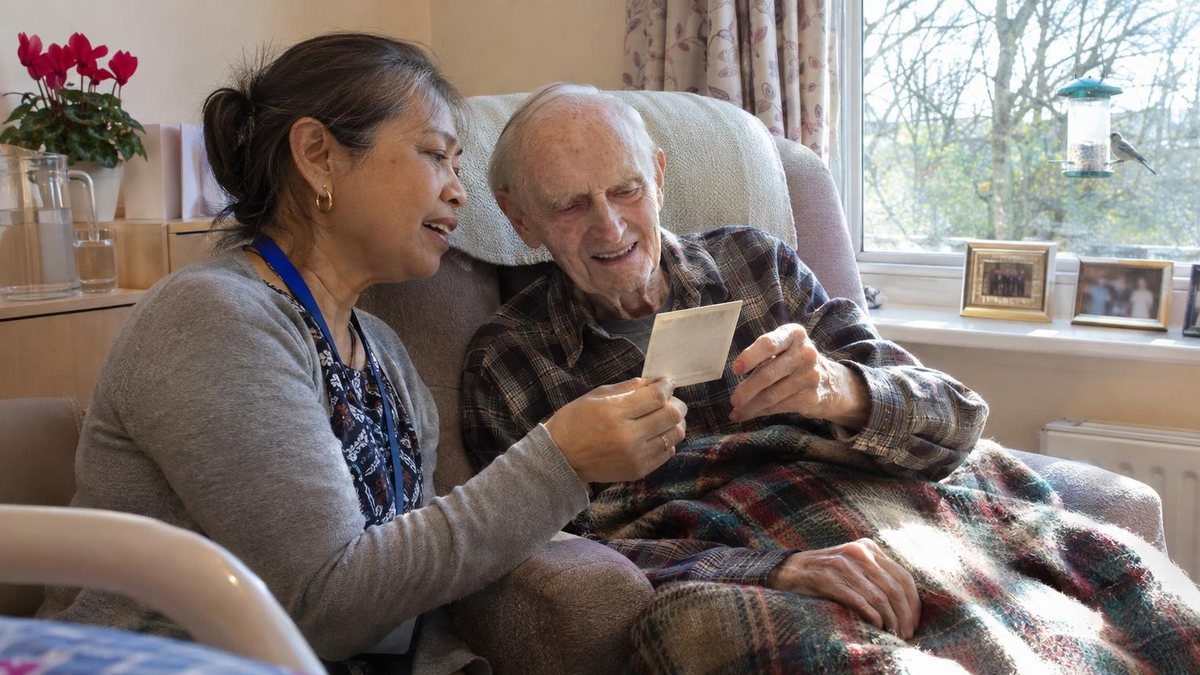
Illustrative image, AI-generated
Life review questions help an older person look back over their whole life in order, from childhood to now, and think about what it meant. This page has more than 60 of them, grouped by life stage and then by theme, with a short section of very gentle questions for bedside visits.
They are written for adult children and grandchildren, for hospice and church volunteers, for chaplains and for care home staff who sit with older people. They also work if you want to review your own life on paper. Each question asks for a story and then, often, for what the person makes of it now. That second step is what sets a life review apart from ordinary reminiscing.
If the answers deserve to outlast the conversation, a memoir written in their own words turns answers to guided questions, written or spoken, into a printed hardcover book the family can keep.
What Is a Life Review?
The idea comes from the psychiatrist Robert Butler, who described it in a 1963 paper in the journal Psychiatry, “The Life Review: An Interpretation of Reminiscence in the Aged.” Butler argued that older people's habit of returning to the past is not idle wandering but a natural process: memories come back, including unresolved ones, and the person weighs them and tries to make sense of the whole.
Later, the nursing researcher Barbara Haight developed a structured life review that walks one person through their life stage by stage over several weekly one-to-one visits, with a listener who asks and then gently asks again. Group “reminiscence work” in care homes and day centers is a looser cousin: shared memories, often prompted by photos, music or old objects.
Researchers have studied both. A 2012 meta-analysis by Martin Pinquart and Simon Forstmeier in Aging & Mental Health, pooling 128 studies, found that reminiscence interventions led to moderate improvements in depression and in ego-integrity (a sense that one's life has meant something), with smaller effects on purpose in life and sense of mastery. A 2018 Cochrane review of reminiscence therapy for people with dementia found the effects inconsistent and often small. So treat these questions as a good way to spend time together, not as a treatment.
How Families, Chaplains and Care Workers Use Life Review Questions
Families tend to use them across a series of visits, taking one life stage at a time and writing down or recording the answers with permission. Chaplains and hospice volunteers often use a handful near the end of life, when a person may want to talk about meaning, regret and the people they love; a related approach called dignity therapy, described by Harvey Chochinov and colleagues in the Journal of Clinical Oncology in 2005, records such a conversation and turns it into a written document the person can leave to their family. Activity staff in care homes use the lighter questions in small groups.
Whoever is asking, the rule is the same: the person answering decides how far to go. If you want lighter, everyday questions to start with, try the lists of questions to ask elderly parents or questions to ask an 80 or 90 year old.
Life Review Questions About Childhood and the Family You Came From
Start at the beginning, but ask how childhood looks from here rather than only what happened.
- When you picture yourself at about seven years old, what kind of child do you see?
- What did your family need from you as a child, and were you able to give it?
- Which grown-up made you feel safe when you were small, and how did they manage it?
- What did your parents hope you would become, and how close did you come?
- What did you have to work out on your own because nobody explained it?
- Which part of your upbringing are you most grateful for now?
- What did your childhood hand you that took years to set down?
- How did the money in your house, or the lack of it, shape the way you have lived since?
- If you could sit next to your seven-year-old self for an afternoon, what would you want them to know?
Questions About the Teenage Years and Leaving Home
The years when a person first decides who they are going to be. Ask about the choices, not just the events.
- Who were you trying to be at sixteen?
- Which friend from your teenage years understood you best, and what became of that friendship?
- What rule did you break as a young person that you still don't regret?
- When did you first notice you had a mind of your own, separate from your parents'?
- What made you leave home, or what kept you close to it?
- What picture of adult life did you carry around at eighteen, and how much of it came true?
- Which door opened or closed for you before you turned twenty-one?
- What were you proud of as a young person that nobody else seemed to notice?
Early Adulthood: Work, Love and Starting Out
The decisions made in a person's twenties and thirties often set the shape of everything after. These questions ask how those decisions look now.
- Was the work you ended up doing a choice, an accident, or some of each?
- What did your first years of earning your own living teach you about yourself?
- Which older person at your first job or in your first home showed you how adult life was done?
- How did you decide who to share your life with, and how do you feel about that choice today?
- What did you give up in your twenties and thirties to build the life you wanted?
- Which early home of yours do you think of most fondly, and what was life like there?
- When did you first feel responsible for other people, not just yourself?
- Which mistake from your young adult years turned out to be useful later?
- What were you most afraid of in your twenties, and did it ever happen?
Life Review Questions About the Middle Years
The busy decades of work, family and looking after others. People often rush past these; slow down here.
- Looking back on the busiest years of your life, what were you working toward?
- What did raising children, or choosing not to, teach you about yourself?
- Which single year of your middle life would you call the best, and why that one?
- What changed between you and your partner, or in your friendships, once the children left home?
- What did you do in those years that you would do exactly the same way again?
- What did you put off during your working years that you wish you had done sooner?
- Who depended on you most in midlife, and how did that weigh on you?
- When did you stop worrying about what other people thought, if you ever did?
- What did your work, paid or unpaid, add to other people's lives?
Questions About Later Life and Growing Older
The stage the person is living now. These questions take it as seriously as the earlier ones.
- Which part of growing old turned out differently from what you had been led to expect?
- What has been easier than you expected about this stage of life, and what has been harder?
- What pleasure have you found in these years that the busy decades left no room for?
- What does an ordinary day need to have in it now for you to feel it went well?
- Who came into your life late and made a real difference?
- What have you made peace with in the last ten or fifteen years?
- What do you understand about your own parents now that you couldn't see at the time?
- What would make the years ahead feel well spent to you?
Questions About Hard Times and How You Came Through Them
Butler saw the life review partly as a chance to come to terms with what went wrong. Offer these; never press. A person may answer one today and leave the rest for another visit, or for never.
- Which stretch of your life was the hardest to get through, and how long did it last?
- What got you out of bed in the morning during the worst of it?
- Who stood by you when things fell apart, and have you been able to tell them what it meant?
- How are you different today because of someone or something you lost?
- What did a hard time give you that you would not have chosen, but would not give back?
- Is there a painful chapter you see more kindly now than you did while you were in it?
- What would you say to someone going through what you went through?
- Is there anything from those years you are still carrying that you would like to put down?
Looking Back on the Whole of a Life
These come last because they ask the person to stand back and see their life as one piece. They are often the questions families most want answered, and the ones that need the most patience.
- When you look over your whole life, what are you most glad you did?
- What thread do you notice running through your life, from childhood until now?
- Is there something you always felt you were meant to do, and did you get to do it?
- Which of your big choices would you make again without a second thought?
- Which of your decisions looks different to you now than it did when you made it?
- Is there a plan, a promise or a conversation you would still like to complete?
- Which relationship would you most like to mend, or to say thank you for, while there is time?
- How do you hope the people who love you will describe your life?
- In your own words, what has your life added up to?
- Who would you most like to hear the answers you've given today?
Short Life Review Questions for Bedside Visits
For someone who is very ill or tires quickly. Each needs only a sentence or two, and any of them can lead somewhere longer if the person wants it to.
- What is a memory that makes you smile right now?
- Is there someone you would like me to call or write to for you?
- Which photograph would you like us to look at together?
- What song would you like me to put on for you?
- What small thing went well for you today?
- What would you like me to remember from this visit?
How to Ask Life Review Questions Gently
A life review can bring up old grief as well as good memories, so how you ask matters as much as what you ask.
- Say why you are asking: “I'd like to hear your life the way you see it” is enough.
- Go in order, one life stage per visit. It gives the conversation a shape and gives you both a reason to come back.
- Ask the story first and the meaning second. “What happened?” comes before “What do you make of it now?”
- Leave silences alone. The considered answer often arrives after a pause of a minute or more.
- Don't correct dates or argue with their version. This is their account of their life.
- If a question upsets them, let it go and move to something lighter. Tell a nurse, chaplain or social worker if distress lingers after you leave.
- Ask before you record, and offer them a copy of anything you write down.
- With someone living with dementia, use photos and objects as prompts, keep questions short, and follow where they lead rather than going in strict order.
How to Keep the Answers
Write the answers down as close to word for word as you can, with the date of each conversation, and keep copies in more than one place. Read a few back at the next visit; people often add something important the second time. If they would like to go further at their own pace, see how Memowrite works: they answer guided questions about their life by writing or speaking, and the answers are printed as a hardcover book.
Frequently Asked Questions
What is a life review?
A life review is a structured look back over a whole life, usually in order from childhood to the present, in which the person both remembers events and reflects on what they meant. The term comes from the psychiatrist Robert Butler, who wrote about it in 1963. It can happen in conversation with family, with a trained professional, or on paper.
What is the difference between life review and reminiscence?
Reminiscence is simply recalling the past, often in a relaxed group, and it can jump around freely. A life review is usually one to one, follows the life in order, and asks the person to weigh their experiences, including the difficult ones. Many families do a little of both.
Are these life review therapy questions?
They are written for conversation, not for therapy. Life review as a therapy is delivered by trained professionals who are prepared for painful material and know when to refer someone for more help. If the person you are visiting is struggling with low mood, talk to their doctor or care team.
Can I use life review questions with someone in hospice care?
Yes, gently and in short sessions. The bedside questions above are a good place to start, and many hospice chaplains and volunteers already use questions like these. Follow the person's energy, stop when they tire, and check with the care team if you are unsure.
How long does a life review take?
There is no set length. A structured life review is usually spread over several weekly visits, about one life stage at a time, but a family might take months, and a bedside conversation might cover only one or two questions. Let the person set the pace.
Keep the answers in a book
Memowrite asks the questions, your parent or grandparent can answer by writing or speaking, and the stories are printed as a hardcover book the family keeps.